The End Times—Excerpts from an Untitled Work in Progress
The Diary of Proxima Selinne
August 2nd, Morning.
Amidst such desolation, we find ourselves grasping for the company of creators. We seem to cling to one another with such frantic desperation, as though one throw-away word from our prolific kin will send the hellhounds yipping skittish and whining back to the fiery chasms from whence they came. Reynard is taking us from the city to stay with his acquaintances—I fear he is chasing them down in hopes their art—their writing, their philosophies—will stave off the end. As though holding fast to the old world will spare us. As though grasping at creation will remold our fate. He has always been more optimistic than I.
For what reason I write a record of these happenings I do not fully understand myself. There is a futility clawing at me as I put pen to paper—in my deepest recesses I intuit there will be no one to read these pages. I admire Reynard’s ignorance. He believes we shall scratch out our thoughts, our fears and it will preserve our small lives because, as he often says, humanity will be cold in its grave if art no longer lives. We shall make use of the end, he says. We shall have a lifetime of material to fuel our work. I find it simple he believes his own tongue as it forms the word lifetime.
We leave imminently. The city is a cesspool of hysteria. Reynard has arranged our travel to Beauvis Grinslou’s estate in the country. He and Reynard were schoolmates in college—they met abroad during their studies. Wealthy as a lord of the olden times, Beauvis is. He remained in the city with Reynard and the others upon graduation, too enraptured by their guild of writers to return to his family’s permanent address—somewhere Reynard has been for holidays and described to be a castle of ghosts, for the small clan of Grinslous detest one another pitifully. Beauvis prefered to live as his peers did—the starving artists scraping together what funds they could for university fees through odd jobs and unsavory work like their strange comrade, Pask, or those who found footing near the economic base of the sheer cliffside this city has become, employed long hours with only their club’s late-evening meetings to settle down and write—return to their practice. I detail the Grinslou heir’s life to explain why my bags are packed and waiting beside the door, and why, in a handful of minutes, Reynard will be ringing my bell to call me down.
The family has remained in their vault of a home, far from here, pitifully counting their gold coins as the end draws nearer and nearer. Their summer estate, north of the city a few hours’ drive, remains vacant. The idea to retire there instead of waiting for the city to swallow itself whole with panic and…changes…had not occurred to Beauvis until my dear Reynard pitched it. Beauvis, naturally, was eager to invite us, forgetting quite swiftly it was not his brilliant suggestion to find refuge there. His stingy relations refuse to exit their walls—there will be nobody to deny our stay at the estate.
I’m rambling, yes. My nerves are growing fitful as I wait for my Reynard to arrive with the car. I fear the journey will stretch longer than it once would have—everyone decided simultaneously it’s time to flee the cities. Our urban fortresses have become stone and mortar tombs. None want to be buried alive in the graves we dug for ourselves.
I hear the familiar guttering of Reynard’s car and its poorly, twice-repaired motor. Wish me luck on the drive.
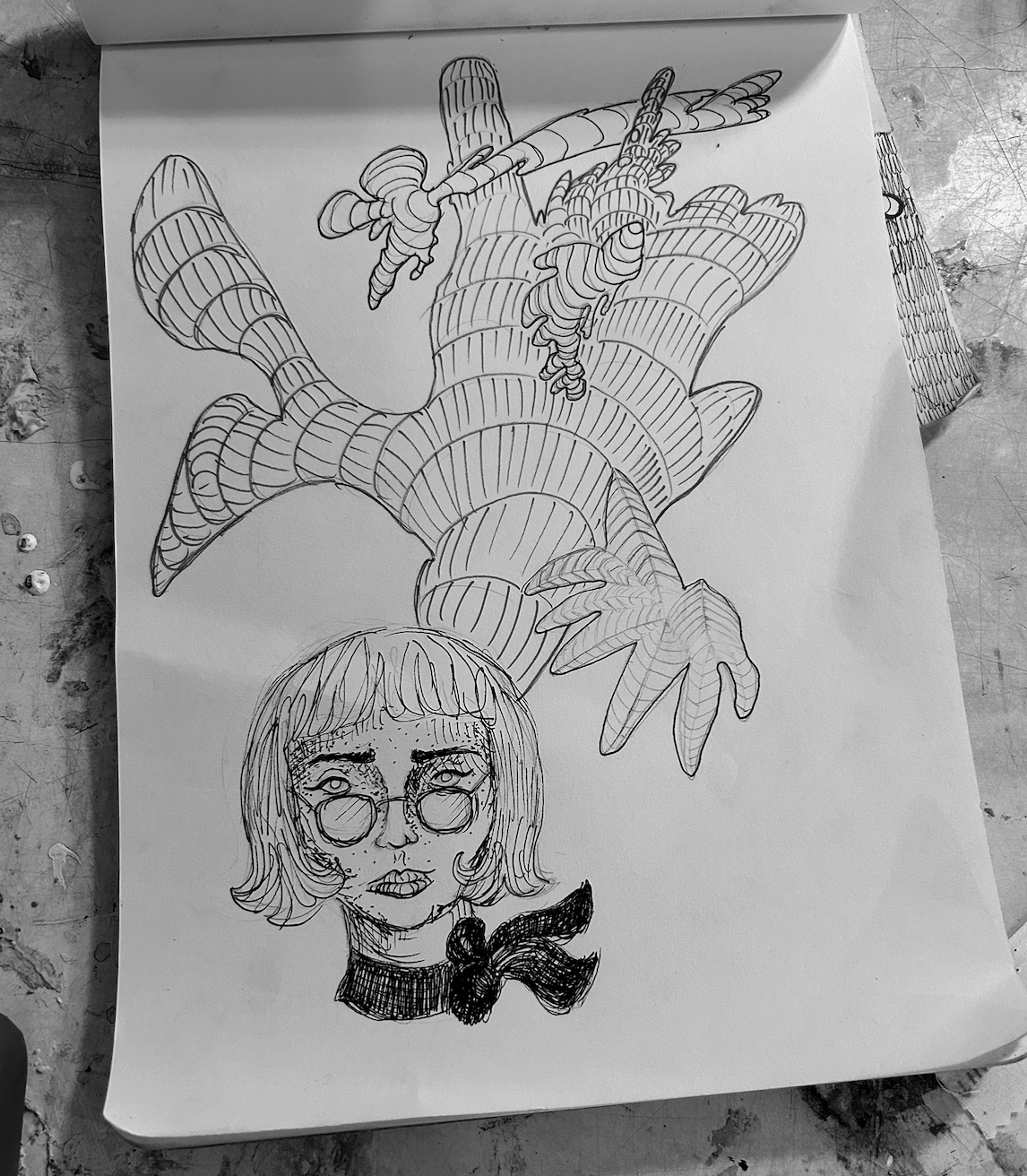
August 2nd, Night.
As I expected. We’ve been trapped on the congested roads, unmoving for hours at a time. It was well into evening before we were truly able to put distance between us and our former, maddened home. Reynard and his good breeding wanted to find accommodations in one of the towns off the highway—we pulled off twice to find shutters locked and lamps all extinguished. Children watched us through windows with the resigned eyes of the haunted. We’re sleeping in the car tonight. Reynard is cheerful, acting like we’re on a honeymoon or a road trip over spring break. He thought I couldn’t see the fear in his gaze as he searched for a place to rest, eyeing the woods bordering the freeway with terror he wants to believe he’s tamed into submission. I saw the grimace beneath his smile as he told me he was going to ‘answer nature’s call’ behind the scrub of bushes nearby. I heard the dismay in his voice at the irony he failed to preempt in the saying—answering nature’s call means something vastly different now. We still stumble in this new reality, holding all the baggage of normalcy from the old days as it grows heavier and heavier, and yet we refuse to leave any of it behind.
August 4th, Morning.
Late last night we reached Beauvis’ summer estate. Our sleep on the roadside was fitful at best—I don’t believe Reynard slept. Not with the woods looming so, not with the dense shadow beyond our car. There is something in the way our human creations, our machinery, feels even more like a target in these instances. As though the end times want to eat away our detriments like rust. I’d rather not get into that car again for a while; if anything I say is to be believed, strapping oneself into an automobile is as foreboding as lying naked and bleeding in the territory of wolves. Whatever it is that has been birthed by the end, it is wholly natural—unnatural, natural, they mean quite the same thing—and it has a vengeance for our machinery. For all we’ve created.
I stopped counting how many cars we passed that had been long abandoned, crushed like they’d been driving towards an oncoming train, but with no sign of another vehicle, no cause. Pulverized, the engines caved in, shards of glass and metal pooling like blood on the side of the freeway, they were overtaken by growth. Mosses and lichens and fungi, knotted branches sprouting from shattered windshields. Yet I swear the plants eat at it. They look to be decomposing—yes, the metal, the motors, they’re decomposing.
Perhaps I am hysterical. Perhaps the end times have gotten to my head as surely as they have everyone else’s. Perhaps this sanctuary of Beauvis’ estate will clear my mind.
Transcriptions…
Day Two: August 14th, the Grinslou Estate.
Novella Liss, interviewing
Subject: Proxima Selinne
NL: We haven’t really had a chance to get to know one another. Being stuck in this villa—likely until we leave this life—I figure it’s best to acquaint ourselves.
PS: Why of course. It’s been pleasant to have the company of women here. The first two weeks or so, with it being just Reynard, Beauvis, Pask and myself, were pained. Such immense masculinity at odds with the end times.
NL: I can only imagine. Our discussion in the garden before getting caught in the storm was telling. I’m sure it was just you and that overtly boorish, man’s mentality. Beating the apocalypse if you’re a strong enough man, right?
PS: Unfortunately, yes. And now this game—competition, whatever it be that Beauvis has put in place. I’m not entirely sure how I feel about it.
NL: I’m not either. I was never a fiction writer, not a poet. But out of curiosity, what are your reservations with the idea?
PS: As I was saying, they’re going about this as men have always gone about things. Better than thou. They don’t see whythis has come upon us. I should say, Beauvis and sadly, my Reynard. After the argument, I came to realize Pask was of an agreeable position—that is to say, he aligns with how I see it.
NL: It was a relief—perhaps a success—to hear him go off on Beauvis. Someone needs to stand up to that man. Incredibly gratifying to see someone Grinslou has posited as subservient to do such a thing.
PS: Were you well acquainted with Beauvis and Pask in college?
NL: Not whatsoever, aside from a brief introduction to Beauvis at the winter ball one year. Valentine and I are incredibly close, so naturally I’ve met her immediate family, and a handful of the outlying relations.
PS: You never met Pask back then?
Note: She paused, she hesitated. The faintest rosebud blush took to each apple of her cheeks. Her eyes, a mossy green not dissimilar to the new foundations of overwhelming growth in our world—each day new layers of lichen, moss and fungi bury our human architecture—flickered with a momentary fear, a momentary knowing. Like the cap I remove from the lens of my camera and return to encapsulate a memory, imbue history and feeling on those sheets of glass, so flashed her eyes. Her brows are thick and dark, and they nearly touched as concern brought a crease to her forehead. She knows something. She knows something about Pask and me.
PS: Or my Reynard? We all attended the college, though they kept our departments so isolated—for what reason, I couldn’t begin to understand because in different mediums, there is cross-bred inspiration more potent than the singular. A writer may read a book or poem that alights a spark in them, but a writer who reads and studies paintings, studies sculptures, they will tell themselves myriad more stories born of other art.
Note: She is a composed woman but still shows every card in her slim hand. Poets. They so brazenly bare their deepest secrets, their emotions scribbled in brazen vulnerability for anyone to read. They can do little to rein in those tendencies in any other setting. She most definitely knows something of my ties to Pask.
NL: I likely crossed paths with Reynard at some point—I was a journalist and photographer, and I spent some time making photographs of students with their work. Pask, I met on one such occasion. He posed for a photograph. I could resist singling him out, not with the mass of freckles marking his entirety. I prefer the more unconventional subjects.
PS: Oh! I most definitely saw your work displayed, then. Quite lovely to put these little details together from our past. No matter how futile it remains to linger on memories of before.
NL: Indeed. Two things can be true at once. Futile and beautiful. But you were saying…your reservations? I didn’t get the chance to hear the rest of your thoughts.
PS: Ah, yes. Well. I suppose the best way to put it is to say I fear their denial is dangerous. They don’t understand—Beauvis especially, but even Reynard—what’s happening. Not to say I grasp the origins or the science or the method behind the apocalypse. But they believe they can weather it. They act as though this biblical Armageddon is purging the world of sinners, of non-believers and they are the devout undoubtedly saved in their faith. No—more than that, they seem to believe they are the saints offering absolution. This estate is Beauvis’ holy land, his church, and he believes we are his parish.
NL: And this ties into the game…
PS: Because it’s another medium for ignorance. Futility is the word I must return to. I am well aware we are but insignificant beings within the grand scheme of an ecological revolution. In saying so, I know anything we do in this remote…call it either a haven or a—a hospice perhaps, somewhere we’ve all gone to live out our final, sick days—is trivial. Whether or not we play along with Beauvis’ game, it’s of no consequence to the…
Note: Proxima pauses, she hesitates. We are sat in one of the parlors. She leans upon a pale green velvet settee. Her arm strewn over the puckered back; her fingertips make a pilgrimage from where they twined a lock of her hair incessantly to the windowsill just behind. The pane stretches to the ceiling where filigree is molded in white plaster, breaking the sky-blue walls like harsh-set clouds. She is gazing out the window as she trails off in both reverie and…fear. Outside it is a midmorning made of ash. Low grey clouds and a thick fog hangs wet and warm and so humid my skin feels sticky even within the walls of this haven (refuge, hospice, prison, tomb). The window opens to the back courtyard. The rose garden is split by stone pathways, white marble benches, their legs stained with the murk of moss and warped by flighty glimmers of white mushrooms giving the appearance of marble infected with a pox. Pask has manicured the roses. He squares and rounds and yet they grow back stubbornly wild overnight. I recall roses being red and pink and yellow. These have gone cream, a shade like aged parchment or pus, with bleeding hearts; the petals are stained at the center with a brown-red like old blood. I follow Proxima’s gaze because it is deadly silent in the parlor, and I hear her inhale. A small, sharp breath cutting the silence. A shadow lingers among the roses, moving slowly within a fog so opaque I could not quite tell whether or not it’s a trick of the light and my own dread for the unknown surfacing, or if something wades corporally through the oppressive gloom. The shadow is moving methodically between the rows of tamed botanicals, crouching, rising again. One hand, as it draws closer and we can see it clearer, is too long. One hand hangs at its side too thick and pronged like…
Shears. The shadow is materializing, and it has copper hair muted in the dim grey morning. Pask wanders closer, wielding garden shears. He stoops to trim the vegetation in shirtsleeves. I can see now the white undershirt is blotched with spreading sweat. The blades hunker around an unruly branch. I see his bare, freckled arms flexing with effort. The offending branch cracks. I swear I watch as it oozes sticky fluid droplets. He puts the refuse in a tin bucket and stands. As he rises, he sees us through the window. Proxima leaning over the pale green velvet settee, me lounging back on a matching armchair. He stops his gardening to stare at us entirely expressionless, emotionless. I hadn’t realized my nails were digging into the dark varnished wood arm of the chair. He turns without acknowledgment and slips to the next row, the fog dematerializing his familiar form.
Proxima releases a breath she had been holding and shifts to look at me, the terror only half dissolved.
PS: My apologies. I thought I said too much.
NL: No need to apologize, but…what do you mean? Said too much about…?
PS: The beings.
Note: She is looking into my soul like a child looking to her mother for comfort upon waking from a nasty nightmare.
NL: I don’t understand…
PS: (Whispers) I believe it is alive.
NL: It?
PS: The nature. The plants, the water. It’s alive.
NL: Well, yes—
PS: No, I mean it’s…nature is reclaiming what we’ve done. It’s grown sick of us. It’s rebelling.
Note: She checks the rose garden to find it holds only the still fog.
NL: I don’t disagree—
PS: I believe it’s become sentient. It’s living and it’s angry. I can’t say whether it’s one consciousness spreading thousands upon thousands of fingers in every direction until we’ve been stifled or if it’s many beings, perhaps a hive mind of sorts, or if it’s something else entirely, but I do know it’s alive. It’s thinking and it’s acting.
NL: How…do you know?
PS: Can’t you feel it? Everything that’s changed has been far from random. It feels like war, doesn’t it? Like a strategic attack on humanity. Each instance in which we see this mutant nature consuming our conceptions of normalcy…it does so with intention. I can feel the hurt.
NL: I suppose I haven’t been paying close enough attention…
PS: Reynard says I’m too sensitive for this world—our old world, he meant, but most definitely this new one, too. He teases me for being so empathetic. All of that awareness is heightened now. It sounds absurd—
NL: (In a whisper so low it’s barely audible) I don’t think it’s absurd.
PS: I know we will likely die within a year, probably sooner. But I can’t find it in myself to be angry, to push back against the end because…even though I’m scared, of course I’m terrified of the changes, I sympathize. It’s healing itself through this rebellion. Curing itself of us. We’ve been a plague.
Note: I will be candid. My knuckles are white upon the chair’s arm, and she’s shaken me.
NL: Well…I must say I cannot wait to read what you craft for Beauvis’ game.
PS: I don’t quite know where to start, but…you know my sentiments now.
NL: If you were worried about…offending it…I wouldn’t be. You are nothing if not virtuous and respectful to…it.
PS: I don’t worry over my depictions. I worry for the others.
End of recording.
A Rough Draft from Reynard Smith
Chapter Four
Without another moment’s delay, Blackwood and I were passengers in Condor’s automobile, speeding devilishly to the lighthouse, to the very site of the apocalyptic origins. Fear lay in a cold sweat on my skin in the backseat. Condor was silent, his square face set on the road ahead, his square glasses taking in nothing but the winding stretch of gravel. With one hand on the wheel, he navigated us in sharp jolts around potholes and dips, his other hand firmly clamped with cigarette after cigarette.
Blackwood’s tale and our subsequent delve into the archives had eaten up the daylight, and I watched the hills, at one point dotted with sheep, so innocent in their pastoral simplicity, begin to disappear into an oozing darkness. Night had crept upon us with a sudden poison, bringing a thin mist along with it as we neared the coast. Everything dissolved save the beams of round light piecing the undulating fog, making stark the dirt road.
Neither Blackwood nor I felt much like talking in the interim drive. So much had been said earlier. Dread had tied our tongues.
Reaching the lighthouse might confirm our suspicions, might assuage our fears. We were not long to wait until the answer became clear.
Condor’s automobile halted abruptly, sending me crashing into the front seat. A wire fence had been raised, appearing from the growing fog and darkness like an apparition.
“We’re here,” Blackwood stated grimly. “There’ll be no one to open the gate anymore. We’ll have to go on foot, I crawled through a gap just a few dozen yards around the perimeter.”
Condor glanced briefly at Blackwood with his hand on the handle, hesitating to open the door and be once more in the nightmare he had only just escaped. My former professor turned back to face the gate and laid his foot on the gas.
The engine guttered. In a squealing collision, Condor drove straight through the gate, which shredded to the wayside at the behest of the terrific motor vehicle. Metal on metal pieced our ears, and Condor, a cigarette clamped wetly too firmly between his lips, winced as he powered us into the disaster site.
“Good god, man!” Blackwood exclaimed, gripping the frame of the door.
“I’d prefer to have a swift escape if we need it,” Condor answered calmly, winding up the gradual hill.
The headlights hit the base of the lighthouse, which loomed in absolute dark, wreathed in a swirl of mist. Condor cut the engine and got out without another word. The trunk clanged shut, and he reappeared at the window with his old military bag slung over his shoulder, a torch lighting a ring of white at his feet, and two more in his other hand.
Blackwood and I, with rather great hesitation, joined Condor in the darkness, taking the cold metal light in hand, and flicking them on. Three halos cut through the mist, weaving a path along the grass.
“How come I don’t…see anything?” I asked slowly, sweeping the weak, green grass already crystalizing with a layer of thin frost.
Blackwood scoffed in answer, shaking his head as we reached the lighthouse. A door painted red was askew from its hinges, prodding shards of splintered woods littered the frozen grass before it like autumn leaves.
“Prepare yourself,” Blackwood uttered. “It was not a pleasant sight upon my escape.”
I braced myself, gritting my teeth and holding my breath as a dreadful silence fell upon me as we stepped through the ruined door.
And how the silence fell—how loud had the surf beating upon the shore been? How crushing had it deafened us, the relentless beating surf?
But wait—the silence, it had been there. It had been utterly silent as we’d wound our way to the lighthouse. Where was the reassuring churn and crash of the waves? Where was the perpetual beating of the surf?
Stepping inside, my breath plumed before me. How much had the temperature dropped? How deep had the cold laid in the air? I realized quite suddenly my hands were numb. I huffed my frozen breath into cupped palms.
Our torchlight fell upon ice spattered like blood, organically strewn about and frozen in glistening mounds, reflecting strange colors and blossoming shapes within. Shadows of grey and green and purple bruising the solid matter.
Exactly as Blackwood had told us.
The light smatterings compounded within only a few feet. Climbing the walls like overgrown moss.
The effect was uncanny…it felt as though we walked through a battlefield, a crime scene.
As soon as this thought crossed my mind, as if the mere conception had summoned it, my torchlight fell upon a particularly large mound of ice, a man’s face screaming silently from within, his mouth, stretched wide, drowned in the crystalline water. His body hadn’t even hit the floor entirely. His knees were bent, he had been, in fear or in injury or near death, crumpling to the ground, paralyzed before he found a final resting place.
Blackwood warned us—before we entered, and in Professor Condor’s office, as he told us his tale—of the massacre that had taken place.
He told us plainly, though it took seeing it with my own eyes to truly understand the fatal effects of their attempt to stop the spread.
The scientists planned on slowing the progress by freezing the mutations. They had built a machine, a special gas that could turn seawater to ice—if they could have frozen it, they could have studied it, uncovered where it came from, predicted where its mutations and its growth. They could have saved humanity, perhaps. But instead…
Regardless of the damage it had inflicted, my studies and academic curiosity longed to lay eyes upon their creation.
They had brought their deaths upon themselves trying to stop an apocalypse. They had brought the beginning of an ice age to Earth, ushering in the Armageddon they were trying to stave off.
******
Doctor Blackwood took us to the pinnacle on the lighthouse, where the machine had been birthed and remained, where the view of the destruction beyond would be entirely visible.
As we climbed rounds and rounds of stairs, ascending endlessly, the carnage increased exponentially. More and more bodies encased in ice, notebooks with scrawled predictions of the end of the world glistening as though trapped in museum glass, successfully preserving history. The blooms of decaying color became more visible, molds and fungus clawing to the surface of their wintry prisons. Patches of furry grey mold broke through in places, covering the lumpy mounds in downy hair. Pink and red molds—rather unsettlingly resembling blood—oozed through cracks and spilled down the steps in crystalized, oil-slick patterns. Soon we were grappling for a solid hold, the runnels of ice turning the stairs to a treacherous slide.
At points, we were forced to climb on hands and knees over the bodies frozen as they tumbled down the spiral steps and formed a natural barrier to our destination. By the time we reached the lighthouse’s apex, my shirt was doused in sweat and yet I shivered as it froze to my body.
This level was clear of bodies. The scientists had all seemingly fled moments before the ice cut their lives short.
We were faced by the hunkering form of the machine in the center of the space. A jet of ice shot forth from an opening at its front, out the wide panoramic window to the sea beyond, or perhaps it jutted into the pipe—I could not tell. A sharp wind pierced the space, and the deadly cold whistle of its breath was the only sound in the vast night. Yes—I hadn’t imagined it earlier—the sea was still and silent. I crossed to the window, dodging the iced-over apocalypse engine, to gaze upon the source of uncanny curiosity. In brutal peaks and spiked curves—like the arches of a thousand scythes—the waves were halted. There was no moon to illuminate any movement that may have rustled beyond the leagues surrounding the shore.
“Martin, fellow,” Condor prompted wearily, “this is where you become crucial. Do we attempt to stop the engine? Do we…” The professor trailed off, following the stream of ice, seemingly immobile but faintly glowing as it beamed into the beyond like a commet. More ice seemed to run from its base—the source of destruction. The machine wasn’t ready. It wasn’t complete when they ignited it. All their work backfired because…
Blackwood said the threat was imminent. Their study of the changes made it aggressive. It learned of their plot to stop the invasion. And it intended to beat them to utter annihilation.
“What will happen if we let the machine continue its work, Martin? You theorized, and you studied, and you predicted this phenomenon. We decide now if the time has come for another ice age. Or we risk unleashing the new nature upon humanity in all its biblical vengeance.”
******
If only! If only it were an ice age. Perhaps I’ve begun to simply write my woeful wishes into this work. Perhaps I wish a chill had taken to the world—a chill we could outrun until it thawed. I’ve gotten off course. Write my encounter with the end he said! Turns out I would rather dream up other apocalypses than live within the one here and now.
How I wish I could be Martin Hodgson. How I wish I could have called on my extensive knowledge, my dedication to scientific study, and solved such happenings. How I wish it were as simple as the end times familiar. The classic ice age! Ha! Survivable, right? We’ve done it once, haven’t we? But no! No, it must be this dreadful unknown.
Even if I were Martin…I couldn’t solve this unbeatable unknown. Will Martin fix it? Why, how am I to decide! I want him to. I want Martin to save us.
But how can my hero do such a thing if there is no salvation? What’s the meaning of a happy ending anymore? Why does my heart, so shattered with fear, still believe I can shape the outcome with my pen? Who is my Blackwood? Who is my Condor? Both must be Proxima. Proxima guiding me to enlightenment with her love, her empathy. Guiding me to inspiration as the idolized professors guide Martin to solve this mess. No, no. They are my own imagination. They are figments of myself.
I must ask, then! Can Martin lead my imagination to resurrection? Or—does my imagination lead me to survival? What am I going on about…oh, what am I saying now…I sound mad…I sound rather like I’ve gone mad…