Fantasy
Excerpts from Xylandova

A body dismembered. Severed neck; the light has left the eyes; the pale blue light ceases its infliction, ceases its beckoning halo of greed. Eight grave souls look upon their work, their murder, their salvation. Basked in the lack, they breathe heavy, panting in unison, exertion wracking eight young hearts. Reigning satisfaction in the absence of the pale burning blue light that once bored into their very being.
The sea is roiling, spewing brine on sand like coal dust, like ground obsidian. Black shore is met by the black waters of the north. The storm battering the island slunk back in retreat. The air is leaden with its aftertaste. The body lays on a knoll of slick grass; it has been cleansed by the torrential sob, the grief splitting lightning. There is no moon for the mist to hide. The mother turned herself blind in worry.
The body dismembered in equal. Shoulders torn from the trunk; hands, wrists, shorn from the forearm, from their counterpart; legs stiff and still and wrenched from hips; the neck cumbers the head to stop from rolling—down rain-wet greenery, down the grassy hill’s muddied scalp, down to the fog-drowned gulley.
A pact has been sworn. In silence, the eight young sorcerers gather their keep. They reach for their piece, their fraction of the god they created, their token of the god they destroyed. Shivering as they collect the fragments, gooseflesh on storm-soaked skin as they reach for the mangled god.
The metal is cold to the touch. The brass body is taken into eight loving embraces; they clutch at their god, forged by the finest craftsmen, bellows blew him cool, their lips were bellows whispering magic into his form.
They leave two by two. They rock in the hulls of silent boats. The pilgrimage stretches days, weeks. They return home to patient preparations. The graves were dug long before their god died. Three crypts of finely-made, deftly-spelled chests. Five tombs of gaping cavities—brass bones and crystal innards, glass lungs and sleeping blood eager to awaken. Eager for their hearts to find home. And the body dismembered is placed in the vessel. The land splits, cries, triumphs, rises.
The eight sorcerers have done well. They have done right by the world. Their blood dilutes, their power wanes. Centuries pass in peace. Centuries pass and their execution shapes existence as planned. Growing older, growing weaker, growing weaker and weaker.
When the girl is born, they feel it; they dread. They feel the soft breath of their god. They feel his voice whisper chilling power down their wrinkled necks; buried deep within the land, buried deep in enchantments, never to incarnate—the girl is born and their god utters a sigh.


Guinevieve was free-falling through layer upon layer of cloud. Blinded in the soft grey and bright whites, her heart only slowed as she dropped, down and down, tucked in invisibility, peacefully alone in her descent. Wrapped neatly in mist and fog, she breathed deeply and filled her lungs with the thick dew of a morning in Xylandova. The clouds thinned; she was nearing the bottom, and the mainland would soon be splayed beneath her, green and dense and dark and foreign and nearly a mile of empty air between the mottled mystery and her, her horse, and her kingdom.
She let herself continue, the blanket of white became a thin veil, and she pulled gently on the reins, wanting the briefest glimpse of what existed—what she could only imagine existed in the tangle of forests, the ridges of the mountains, the water reflecting the pale pinks and slight orange of the rising sun. She was told it housed beasts, barbarians, creatures of unsavory design—but here, in the kind sunrise, she could only picture the small villages waking with the dawn, putting the kettle on as the flowering morning arrived with birdsong and warmth—the dew would dry.
Enough was enough—she granted herself small glances down to the mainland while riding in the morning but never lingered. She preferred not to let her imagination run off, preferred not to begin to long for things she didn’t understand and would never experience.
Guinevieve tugged the reins bridling her pegasus, Zephyr, and he rose back into the grey.
She was in no hurry to return to the castle. The knight assigned as her guard for the past seven years had acquiesced her need for pure solitude—her request to fly alone in the morning always emitted a sigh of protest, a hesitant muttering, and a pained restraint. Often, he would give her a few moments head start and follow silently on his black stallion, granting her only the illusion of independence, staying just out of sight, concealed in the semi-opaque cloud surrounding Xylandova for a half mile in all directions. Today, he itched on the edge of the land, the soft green grass crushed under his thick, armored sabatons, letting her ride completely alone.
Her father was dead. Her guard could not protest her desire to be left alone; he could not argue the look in her eyes as she told him, chin high, voice not quite accustomed to the hard edge her new position as queen required. He was staying grounded, stationary on the cliffside, waiting for the hidden sunrise to melt into midmorning spring gold below—he would only see the cloud shift from a slate grey to a brighter shade—and her to return to their meeting place.
She was not as anxious to return to him as he was for her to appear, long, brown, ashen tresses tousled from wind, and a dew staining a freshness on her round, freckled face, becoming more regal with age and title. She was a young queen, only twenty and five years of age, but the kingdom thrust upon her only days ago had already slimmed her pale cheeks and iced her playful, overly large blue eyes into a cold sapphire to parallel the stones on her crown. He could not deny her girlish beauty had become the timeless elegance of a cloud-dwelling queen, but after the morning rides since her father’s death, he could see the vigorous youth alight in her features, before closing like the petals of an evening primrose with the dawn.
As she climbed the misty void beneath her kingdom, pressing through clouds and clearing the rocky cliffs that tapered into a point at the base of the land, she drained the last dewdrops of peace she would taste for the day; like nectar, the sweetness of the water dusting the air, coating her skin, filling her lungs, settled her nerves. The underbelly of Xylandova fattened until she could see the outcroppings of rock jutting organically, signaling she was nearing the wide green expanse of the kingdom’s surface. Her mind emptied on her rides—it filled again as her decidedly tall, slim, mist-shrouded figure rose, each time, back to the land, the pale grey palace looming in its gentle neutrality as though it were something evil, something resembling the unfavorable castles dotting the mainland in swarms of dark magic, patrolled by wolves with red eyes and dragons heaving magma out of withered lips, keeping trespassers terrified and far, far away. Or so she had been told.
The delectable fragrance of the rock and cloud combined into a fresh minerality, and soon she was breathing the heavy scent of loam, moss, grass layering atop the effervescent essence of sky and water and stone. She was back.
Zephyr came bounding up the last stretch of vaporous desolation on expansive wings, beating wind into obedience, and landing, graceful as ever, on the bright green dusting of groundcover clinging to the very edge of Xylandova.


A deep, bellowing growl ripped emanated through the cathedral. The walls seemed to shake with its force and hunger. I scanned the surroundings slowly, terror finally setting in, overlaying the numbness that had pushed me this far.
The rising bog rippled, and I could only watch. Something amorphous peaked, breaking the surface. Like tree branches, thick and knotted and sharp, two points were splitting into the air, ten feet apart. They dripped with long strands of scum and creeping aquatic plants, curving like horns.
Water loudly shed from whatever was coming up for air, streaming off of the bulbous shape the horns—yes, definitely I believed them to be horns—were growing from. Ears, mossy and furred and matted with algae, the head of the beast kept rising.
Eyes, set wide apart across a broad nose blinked away the slimy water pouring from it, a glowering, putrid shade of green that burned me to look upon. A snout, steaming the most putrid smell through quivering nostrils—I was gagging, I was burning with the bile in my throat clawing to get up.
The head of a bull in full view. Its face was as tall as I, at least, its body was coming up, humanoid and muscular and all matted with squirming algae. A thick paw-like hand flicked something reptilian from its shoulder, sending an insignificant creature splashing back into the fetid water.
The bull didn’t open its mouth, but I heard its voice booming, felt its torrent of vile breath. “Slay the mistress who feeds,” the voice uttered in a deep, quaking growl, “and one does not go unpunished. I remain hungry. I let human meat cross my skin, plunge into my being, create orifice with each muddy step. I let my pets feast in their desire before I devour the prey they deliver me. You tear at me with your havoc, you reek of human pride, you do not leave. I will not swallow you gracious. I will break your bones in my teeth and savor, suckling the marrow. Naïve girl. Your blood will wash down the foul souring of innocence.”
The minotaur waded a step, sending ripples buffeting my legs; I nearly lost my footing on the stone. He loomed closer, towering above, a writhing mass of hungry terrain made manifest.
Elris’ battle axe hung limp and useless in my hand. Its double-sided blade would be nothing against the swamp that stood before me, a living creature born from every lifeform in the bog.
“Chain of satiation. You came to tear our chain. You came and sunk your teeth into lifeblood in the name of vengeance. Disruptions. Humans are cruel disruptions to the unfathomable consciousness of land,” the voice seethed, guttural, singing my mind with its ear-piercing omnipresence. “The bog allows naught. Ruin for ruin, your wrongs must end in repentance.”

A sharp whine spliced through the air in her frozen terror. Before she could understand where the sound had come from, a long, elegant arrow was lodged clean through the creature’s neck; the feline had opened its mouth to let loose a roar, but nothing was emitted before it crumpled, toppling off the rock into the water right in front of her—its heavy body setting gentle waves lapping onto the shallow pebbled shore. Paralyzed, her mouth agape, she watched the river redden with its blood and felt the cold droplets of the bloodstained water that had splattered her face and fresh tunic. Sluggishly, the water gave way for the muscled corpse, pushing the dead weight south with the current.
She hadn’t realized she’d dropped her grip on the sword again—it hung lack in the stream, swaying with the current—until she found herself tensing, raising it instinctively in defense of the figure that had appeared suddenly, leaping in a graceful stride atop the boulder where the beast had perched. In its place now stood a tall, blonde man in a tunic camouflaged with the dark green pines, and trousers the shade of shadowed tree bark. He loomed above her in his simple garments, a gold-colored metal vambrace on each wrist glinting with the setting sun, and a heavy belt complete with an array of blades swaying in his steady landing. A massive bow was gripped easily in his thick hand, but no arrow from the quiver slung around his broad back was notched. Guinevieve faltered with her outstretched sword as the man smiled widely, a brilliant grin across his tanned, square face that lifted his pointed, elven ears in a boyishly charming manner. His blonde hair was tied back, but a few tendrils had slipped and framed his face, and he reached up to tuck the stray pieces behind the sharp peaks of his ears. He looked down at Guinevieve in the water with a fierce gleam in a set of solidly emerald eyes, still grinning as he said, in a deep, playful voice, “Welcome to Vallwood.”

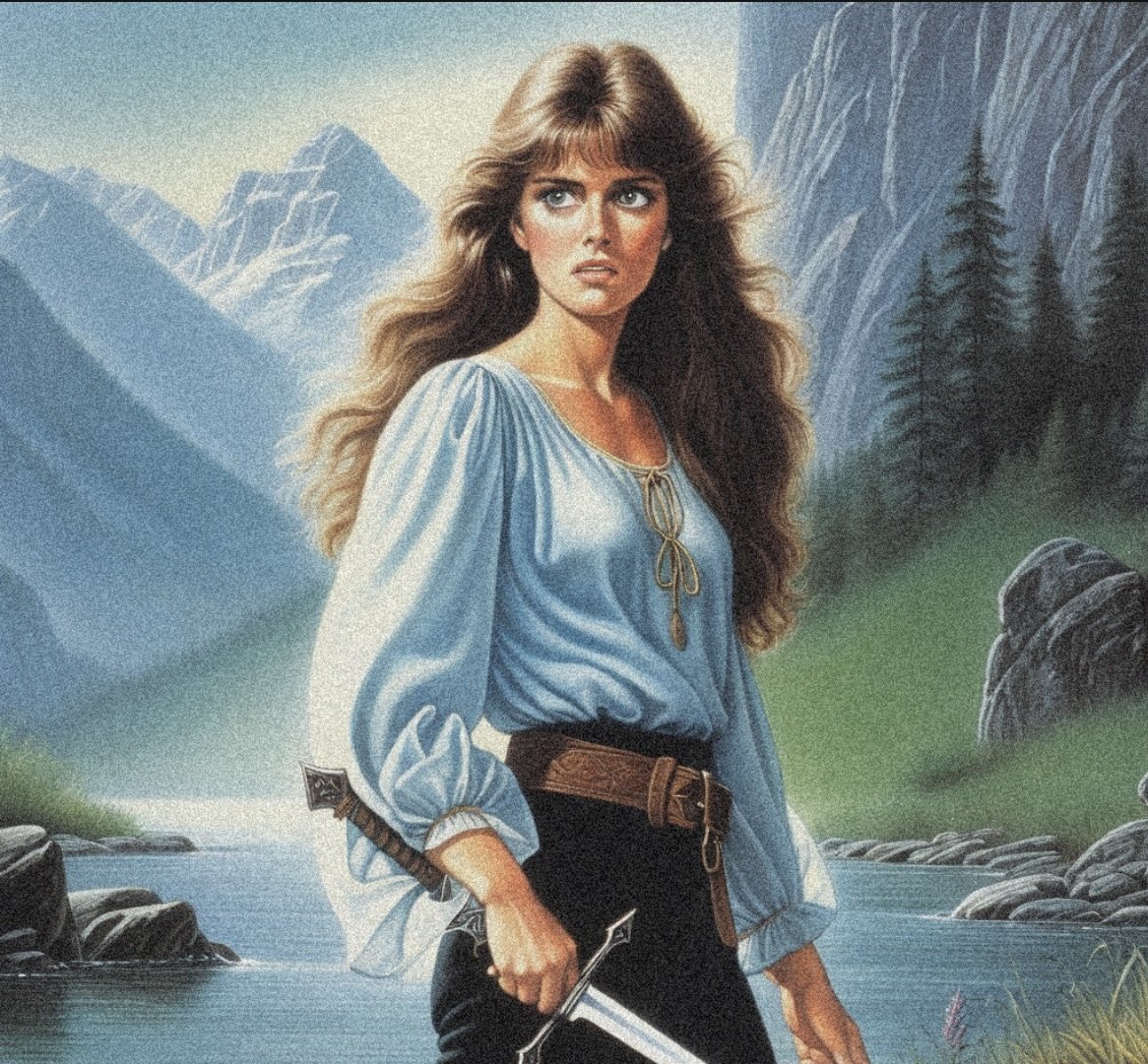

My hair unfurled in the water, a floating halo about my head. I lay in the center of the amphitheater, my silk dress soaked and clinging to my skin, the bandages on my gnarled hand ruined and unraveling. Ara knelt behind me with her hands on my jaw. Dal stood above her, an anchor, keeping a slender hand on her love’s shoulder.
Every citizen had gathered in the open-aired chamber. The masked children running wild through Wisterien’s streets had lost their props and now sat with resolved stillness, paralleling their elders. The Biesou waited, so motionless they appeared to be carved of moonstone themselves.
On my back, undulating in the shallow water, I watched what they awaited. The moon, full and swollen with white crystalline glow, was edging closer to the very apex of the sky above the amphitheater. Perhaps it was an illusion of the reflective mineral the city was built with, but it appeared to have grown so large it would stretch to fill the entirety of the opening.
The celestial body was nearing the pinnacle. The lake’s silver water lapped and murmured as collective movement rippled from the steps. The Biesou knelt as Ara did, as if in prayer, submerging their hands. Eloquent whispering rose in pitch and volume, a melodic chanting replacing the silence—the unison uncannily perfect.
I drifted, felt the swelling lift my body, felt the tide rise in hymn. In my peripheral, I could see the steps to the rows of Biesou flooding faster.
The moon reached her peak, spearing silver and white light fiercely into the chamber, an inferno of ethereal luminescence, reflecting off every surface, including the midnight hue of the Biesou’s skin. Their curled horns phosphorescent, pulling moonlight into their souls like conduits. The molten silver streaks within the protrusions lit angelically, auras enveloped bodies entirely.
Celestial climax had come and the Biesou drew the moon to merge with water once again.
Softly peeling back my skin, cleanly cutting into my muscle, my bone, incising bloodlessly into my veins, slicing tenderly into my skull, I flooded with cold, silver light, a pure sterling power fluid and divine. I rose to meet her, prostrate and dissolving. Each syllable from the holy tongue created lunar conjunction, defied eclipse, birthed molecules of iridescent dew coalescing to lift me in tide, to let their mother see the deepest novae within my soul. The Biesou gave me the moon.
